Research

People at the center
of firm performance.

Organizations depend on people’s expertise, but expertise alone does not guarantee results. I study how incentives, relationships, and organizational design shape where people direct their effort, which opportunities they pursue, and how their contributions add up to firm performance.

Journal articles

7 of 7 journal articles

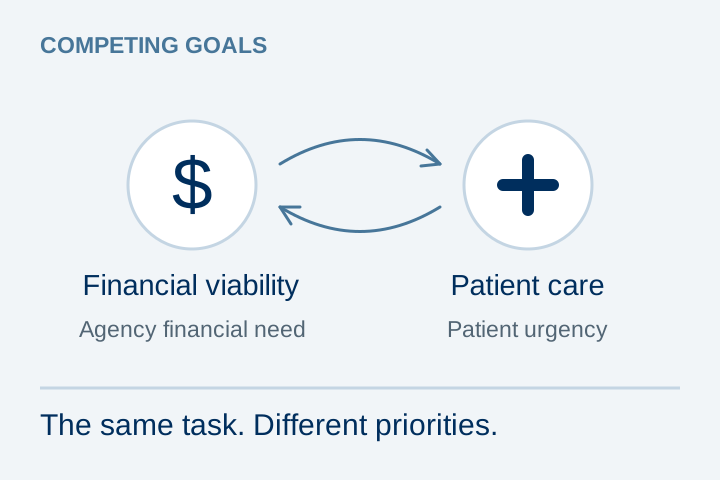
Conceptual illustration: EMS crews shift attention between financial viability and patient care as agency financial need and patient urgency change.
Conceptual summary · Competing financial and social goals
2025

No Margin, No Mission? How Emergency Medical Service Crews Attend to Competing Financial and Social Goals on 9-1-1 Calls

Timothy Gubler, Haibo Liu & Alexandru Roman

Strategic Management Journal 46(13): 3118–3151

Frontline professionals shift priorities as financial pressure and patient needs change.

Summary & citation

Research summary

Using quasi-random assignment of patients to EMS crews across 31 U.S. states, we examine how professionals attend to interdependent financial and social goals within the same task. Crews prioritize the financial goal on privately insured calls, but shift toward the social goal when agency financial need is lower or call acuity is higher. These patterns are particularly pronounced in nonprofit agencies.

Why it matters

An organization’s formal mission does not fully determine what employees prioritize. The study suggests that how professionals understand immediate risks to financial viability and patient care can shape their decisions, even without direct financial incentives.

About the visual

An original conceptual illustration of the paper’s findings. The arrows indicate shifting priorities, not a quantified effect or a zero-sum allocation of care. Financial priorities are more evident on privately insured calls; lower agency financial need and higher patient acuity shift attention toward social goals. Read the source in the paper ↗
BibTeX ↓RIS ↓
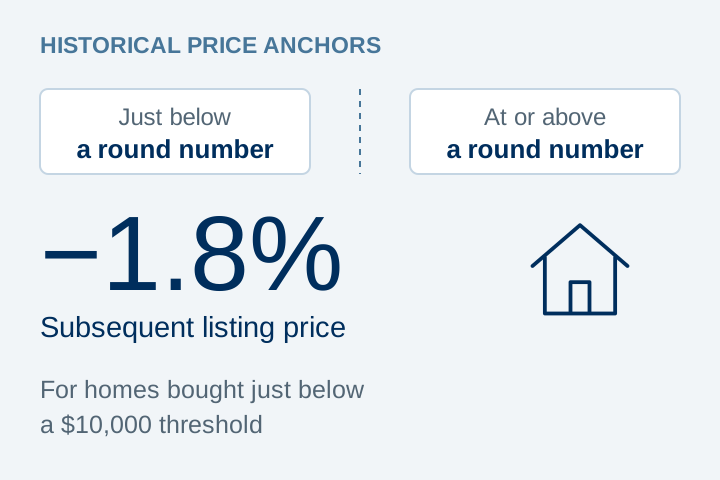
About 1.8% lower subsequent listing prices for homes previously bought just below a $10,000 threshold, compared with comparable homes bought at or above one.
Reported finding · Subsequent listing prices
2023

Anchoring on Historical Round Number Reference Points: Evidence from Durable Goods Resale Prices

Scott S. Wiltermuth, Timothy Gubler & Lamar Pierce

Organization Science 34(5): 1839–1863

A past purchase price can shape a future resale price in surprising ways.

Summary & citation

Research summary

Across archival housing data and three experiments, we find that historical purchase prices anchor later valuations discontinuously around round-number thresholds. Homes previously purchased just below a $10,000 threshold are subsequently listed for less than comparable homes purchased at or above it. Negotiation attenuates, but does not eliminate, the difference.

Why it matters

Paying slightly less today can influence what a buyer asks when reselling later. The findings show how seemingly minor differences around round-number prices can persist through later valuations and negotiations.

About the visual

The approximately 1.8% difference is reported in the manuscript abstract. It compares subsequent listing prices for comparable homes whose prior sale price was just below versus at or above a $10,000 threshold, controlling for home characteristics and prior prices. The two price tags illustrate the comparison; they are not observed group means. This is a listing-price estimate, not an investment-return estimate. Read the source in the paper ↗

BibTeX ↓RIS ↓
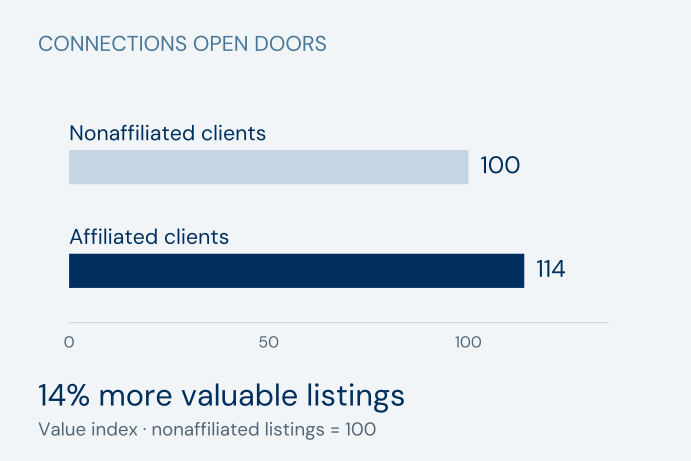
Bar chart: value of listings indexed to 100 for nonaffiliated clients and 114 for affiliated clients, based on the paper’s reported adjusted association.
Reported association · Access to higher-value listings
2019

Socially Advantaged? How Social Affiliations Influence Access to Valuable Service Professional Transactions

Timothy Gubler & Ryan Cooper

Strategic Management Journal 40(13): 2287–2314

Social connections open doors to valuable work and help professionals build a reputation.

Summary & citation

Research summary

Pairing Utah real estate transactions with geographically assigned church congregation boundaries, we find that shared affiliations give agents access to higher-value listings. Affiliated transactions help agents build a reputation that benefits later work with nonaffiliated clients, especially early in their careers and in lower-reputation firms. Affiliated transactions are also associated with lower subsequent entry into entrepreneurship.

Why it matters

Relationships can help a professional earn the first opportunities needed to demonstrate ability. Their value extends beyond one client or transaction because those opportunities can establish a reputation for future work.

About the visual

The chart translates the paper’s reported 14% difference into an index: nonaffiliated listings = 100 and affiliated listings = 114. It is a visual restatement of the adjusted association, not raw group means. Affiliated clients provide access to properties that are worth more; this does not mean the same house sells for a 14% premium. Bars start at zero. Read the source in the paper ↗

BibTeX ↓RIS ↓
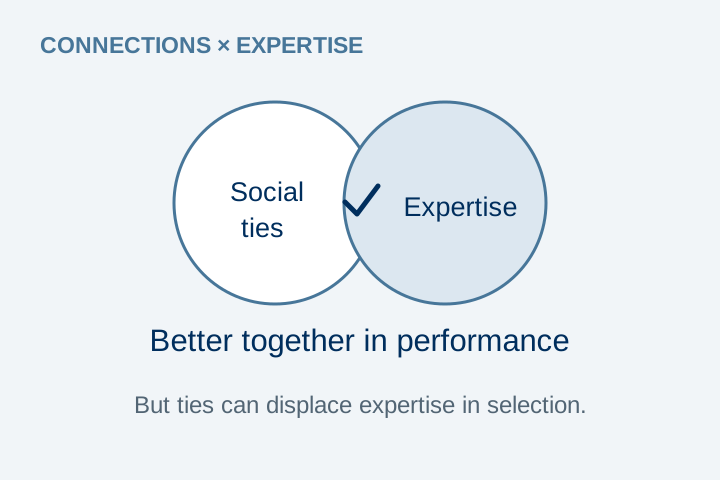
Conceptual illustration: social ties and expertise complement each other in professional performance, but ties can displace expertise when clients select a professional.
Conceptual summary · Selection versus performance
2019

Connected, but Qualified? Social Affiliations, Human Capital, and Service Professional Performance

Timothy Gubler

Organization Science 30(5): 912–936

Connections can improve performance, but can also lead clients to choose less-qualified professionals.

Paper awardSumantra Ghoshal Best Paper AwardAcademy of Management · 2017
Summary & citation

Research summary

Using Utah real estate data and geographically assigned church congregation boundaries, I examine how social affiliations interact with agent experience and expertise. Social and human capital complement one another in transaction performance, but social capital can substitute for human capital when clients select an agent. Selection of less-qualified affiliated agents reduces the benefits of social connections.

Why it matters

Choosing someone you know can help a transaction go well, especially when that person has relevant expertise. The risk arises when familiarity substitutes for evaluating whether the professional is qualified for the task.

About the visual

An original conceptual illustration of the distinction between selection and performance. Social and human capital can complement each other in producing performance, while social affiliations can substitute for qualifications in clients’ selection decisions. Circle size and overlap carry no quantitative meaning. Read the source in the paper ↗

BibTeX ↓RIS ↓
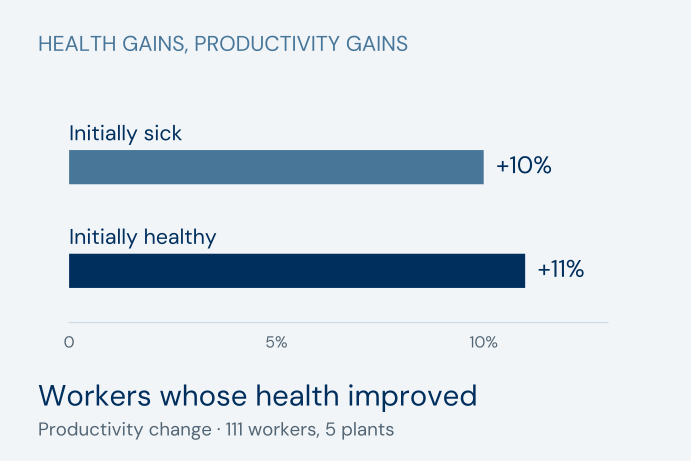
Bar chart of rounded productivity gains among workers whose health improved: about 10% for initially sick workers and 11% for initially healthy workers.
Reported estimates · Workers whose health improved
2018

Doing Well by Making Well: The Impact of Corporate Wellness Programs on Employee Productivity

Timothy Gubler, Ian Larkin & Lamar Pierce

Management Science 64(11): 4967–4987

Employee health improvements can create value through higher productivity.

Research recognitionTop 100 business papers with societal impactFinancial Times · 2020
Summary & citation

Research summary

We link objective health and daily productivity data for 111 workers in five industrial laundry plants. Workers who improved their health increased productivity by about 10%. The findings are consistent with improvements in worker capability and motivation, although the small sample limits estimate precision and our ability to isolate the mechanisms.

Why it matters

The value of employee wellness may extend beyond insurance costs and absenteeism to how people perform while at work. This field study provides evidence of that possibility, while its small sample calls for care in generalizing the estimated gains.

About the visual

The chart shows the rounded subgroup estimates reported in the introduction: a 10% productivity gain for initially sick workers whose health improved and 11% for initially healthy workers whose health improved. These are not average gains for all employees. The study followed 111 workers across five plants; the authors caution that the small sample limits precision. Bars start at zero; uncertainty intervals are not shown. Read the source in the paper ↗

BibTeX ↓RIS ↓
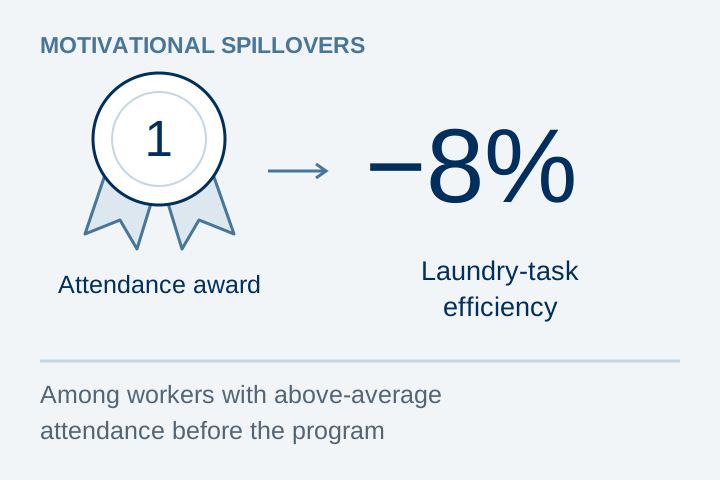
After an attendance award program, daily laundry-task efficiency fell 8% among workers with above-average attendance before the program.
Reported finding · Spillover to a task outside the award
2016

Motivational Spillovers from Awards: Crowding Out in a Multitasking Environment

Timothy Gubler, Ian Larkin & Lamar Pierce

Organization Science 27(2): 286–303

Rewarding one behavior can reduce motivation and performance on other tasks.

Summary & citation

Research summary

Using an attendance award introduced at one of five industrial laundry plants, we examine gaming and motivational spillovers from symbolic rewards. The program improved attendance for some employees, but also encouraged gaming and reduced performance among previously reliable workers. Workers with above-average preprogram attendance lost 8% efficiency in daily laundry tasks after the award was introduced.

Why it matters

A successful incentive cannot be judged only by the behavior it rewards. Managers also need to consider how the program affects employees who were already doing well and the other tasks those employees perform.

About the visual

The 8% efficiency decline is reported in the abstract for daily laundry tasks among workers with above-average attendance before the award program. It does not apply to all workers. The medal and arrow summarize the program and spillover, rather than reproducing an estimated time series. Read the source in the paper ↗
BibTeX ↓RIS ↓
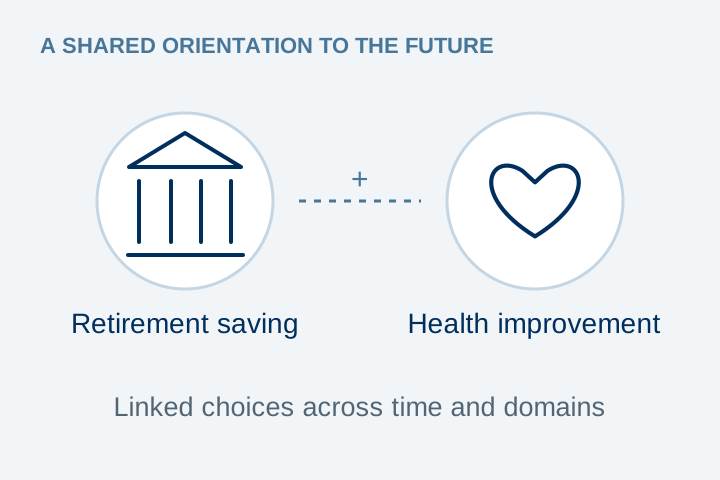
Conceptual illustration of an adjusted positive association between retirement-plan contribution and subsequent health improvement.
Conceptual summary · An association across domains
2014

Healthy, Wealthy, and Wise: Retirement Planning Predicts Employee Health Improvements

Timothy Gubler & Lamar Pierce

Psychological Science 25(9): 1822–1830

Planning for future financial health is associated with acting on future physical health.

Summary & citation

Research summary

Following an employer-sponsored health examination, employees who already contributed to a 401(k) improved abnormal health indicators and health behaviors about 27% more often than noncontributors. The relationship persists after accounting for initial health, demographics, job type, and income, consistent with common time preferences across financial and health decisions.

Why it matters

A willingness to invest in the future appears in more than one part of life. Retirement saving predicts later responses to health information in this setting; the study does not establish that saving itself causes better health.

About the visual

An original conceptual illustration of the positive association between retirement-plan contribution and subsequent health improvements. The dashed connector represents an association, not a causal effect of saving on health. Figure 1 and Table 1 in the paper present the underlying health results. Read the source in the paper ↗
BibTeX ↓RIS ↓

Working papers

For the latest version of a manuscript,
please get in touch.

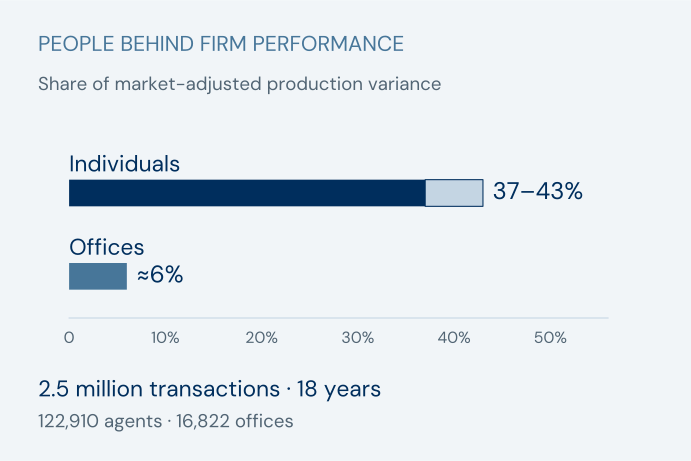
Horizontal bars showing individuals account for 37 to 43 percent of market-adjusted production variance after correction for estimation noise, versus approximately 6 percent for offices after accounting for individual differences. The shaded segment represents a range across estimates, not a confidence interval.
Estimates from the working-paper abstract. Range across estimates, not a confidence interval.
Working paper · Draft September 8, 2026

How Much of Firm Performance Is Human Capital? A Variance Decomposition Below the Business Unit

with Gordon Scott

Individual differences explain much more production variance than office differences; performance also persists when people change organizations.

Abstract & figure notes

Authors

Timothy Gubler · Brigham Young University
Gordon Scott · Washington University in St. Louis

Abstract

Variance decomposition research rarely extends below the business unit, leaving unclear how much of firm performance reflects the people who do the work. Using 2.5 million real estate transactions involving 122,910 agents across 16,822 offices over eighteen years, we separate individual and organizational contributions to production. Individuals account for 37% to 43% of market-adjusted production variance after correcting for estimation noise, compared with approximately 6% for offices when accounting for individual differences. Individual performance persists across organizations, while moves to stronger offices are associated with additional gains. Gains also partly reflect when people move. These findings distinguish organizations that assemble productive people from those that make their people more productive.

About the visual

The graphic uses the estimates in the author-supplied abstract for the September 8, 2026 draft. Individuals account for 37–43% of market-adjusted production variance after correction for estimation noise. Offices account for approximately 6% when individual differences are included. The lighter segment marks the range across estimates, not a confidence interval. The bars start at zero and do not represent all components of a variance decomposition; the shares should not be read as a complete partition or as causal effects.

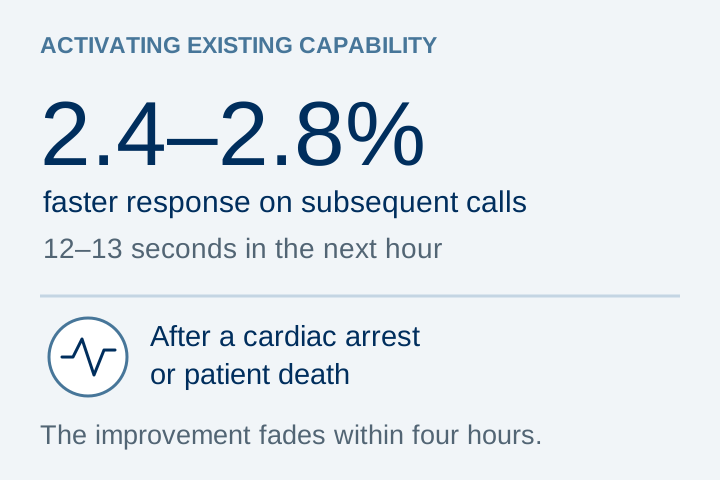
EMS response times improve by 2.4–2.8%, or 12–13 seconds, in the hour after a cardiac arrest or patient death. The improvement fades within four hours. Based on more than 57 million 9-1-1 calls.
Reported next-hour response-time improvement. More than 57 million 9-1-1 calls.
Working paper

Activating Human Capital: How Full-Capability Episodes Shape Employee Productivity in Repeated Work

with Haibo Liu and Alexandru Roman

Demanding calls can activate capability employees already have: EMS crews respond faster on subsequent calls, with gains that fade within hours.

Paper awardSTR Distinguished Paper AwardAcademy of Management · 2025
Paper awardStrategic Human Capital Best Conference PaperStrategic Management Society · 2024
Paper recognitionConference Best Paper FinalistStrategic Management Society · 2024
Abstract & figure notes

Abstract

Firms train employees to handle the most demanding situations their jobs may present, yet most daily work calls on only a fraction of that training. We ask how an employee's productivity changes on subsequent repetitions of a task after one repetition demands the highest level of capability for which the role trains, and whether that change depends on how often such repetitions occur. We term these repetitions full-capability episodes and argue that they temporarily activate employees, raising readiness to apply capability they already hold, without any change in that capability. Using over 57 million 9-1-1 calls from U.S. emergency medical services, where dispatch assigns calls quasi-randomly within a shift, we find that unit response times improve by 2.4 to 2.8% (12 to 13 seconds) in the hour after a cardiac arrest or patient death, a magnitude that affects patient wellbeing. The improvement fades within four hours and weakens with accumulated workload. It is reference-dependent, roughly five times larger where such episodes are rare than where they are common, and smaller for Advanced Life Support units that handle acute calls routinely. It also appears after emergent dispatches cancelled before patient contact, indicating that the call on capability, rather than its deployment, drives the response. Human capital utilization thus varies within a role and within a shift, similar firms realize different productivity from similarly trained employees depending on how often work calls on their capability, and underuse carries a productivity cost alongside the costs of overload that prior research emphasizes.

About the visual

An original summary of the author-supplied abstract. The 2.4–2.8% improvement (12–13 seconds) applies to unit response times in the hour after a cardiac arrest or patient death. It is a range of reported effects, not a confidence interval. The improvement fades within four hours and weakens with accumulated workload; it is larger where these episodes are rare. The illustration does not depict an estimated time series or a change in underlying capability.

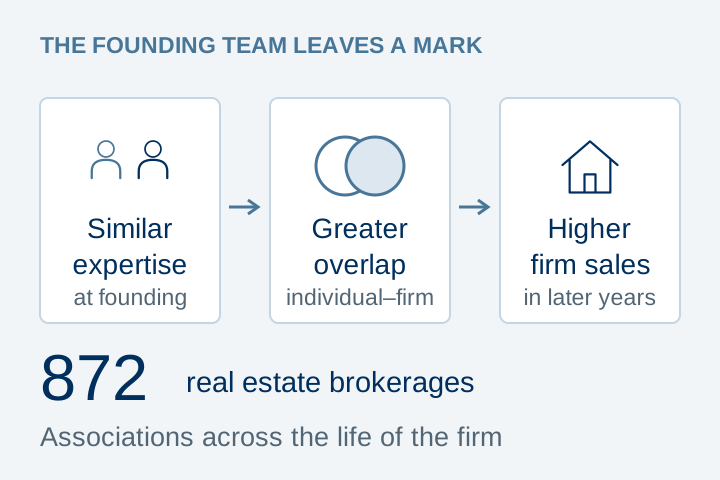
Conceptual illustration of associations in 872 real estate brokerages: similar expertise among founding agents is linked to greater individual-firm human capital overlap in later years, which is linked to higher future firm sales.
Conceptual summary of associations in 872 real estate brokerages.
Working paper

Individual-level Origins of Firm-level Human Capital Resources

with Ryan Cooper and David Kryscynski

Similar expertise among founding team members is linked to lasting alignment between individual and firm expertise—and higher future firm sales.

Abstract & figure notes

Abstract

Understanding the emergence of firm-level human capital resources from individual-level human capital is crucial to explaining how firms can create and sustain competitive advantage from their people. We theorize that higher similarity among the individual-level components of a firm’s founding human capital resource leads to higher subsequent average overlap between individuals and the established firm-level human capital resource, and that this higher overlap improves firm performance. Analysis of individual- and firm-level human capital portfolios constructed using data from 872 real estate brokerages suggests that higher individual-level human capital similarity among agents at founding positively relates to individual-firm human capital overlap in future years, and that higher individual-firm human capital overlap positively relates to future firm sales. These results imply that managers from founding onward must carefully craft and manage individual- and firm-level human capital resources to generate persistent performance advantages.

About the visual

An original conceptual illustration based on the author-supplied abstract. Higher similarity in agents’ human capital at founding is positively related to later individual-firm human capital overlap; higher overlap is positively related to future firm sales. The connectors show the proposed sequence of relationships, not quantified or independently established causal effects. The finding concerns similarity in human capital, not demographic similarity.

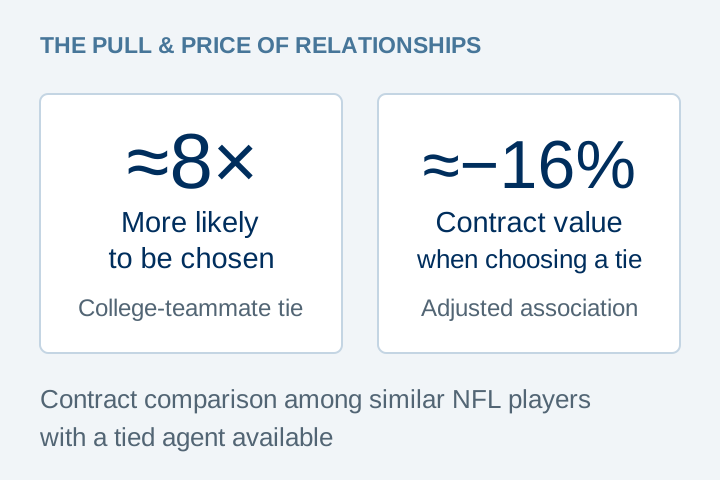
An NFL agent who represents a prospect’s college teammate is roughly eight times more likely to be chosen. Among observably similar players with a tied agent available, choosing the tie is associated with contracts roughly 16% less valuable.
Reported NFL agent-selection and contract associations. Comparisons detailed below.
Working paper

Selection in Professional Service Settings: Unpacking the Impact of Human Capital, Social Capital, and Reputation

with Ryan Cooper and Jim Oldroyd

Relationships dominate NFL players’ choice of agent. Among similar players with a tied agent available, choosing the tie is associated with less valuable contracts.

Abstract & figure notes

Abstract

Professional services are credence goods: buyers struggle to evaluate quality before purchase and often even after services. Under these conditions, how do buyers choose among expert providers, and does the way they choose cost them anything? We compare the three signals most prominent in prior work—human capital, relational ties, and reputation—using the population of National Football League contract negotiations from 2007 to 2011: 10,183 agent choices by 6,070 players across 670 certified agents. Conditional logit models show that relational ties dominate selection, accounting for roughly 90 percent of the explanatory power the three signals add; an agent who represents a prospect’s college teammate is roughly eight times more likely to be chosen. Human capital matters only through position-specific experience, and credentials not at all. Reputation gains ground among star players but never overtakes ties. Using contract outcomes, we find that the cheapest signal is not free: among observably similar players with a tied agent available, those who chose the tie signed contracts roughly 16 percent less valuable, a gap that widens within player and disappears only for veterans. In credence goods markets, relationships clear the market for the typical buyer, and the typical buyer pays for it.

About the visual

An original summary of the author-supplied abstract, covering NFL contract negotiations from 2007–2011. The approximately eightfold selection comparison concerns agents who represent a prospect’s college teammate. The approximately 16% contract-value gap compares observably similar players who had a tied agent available and chose that tie versus those who did not. It is an association, not an estimated causal penalty for every player. The abstract reports that the gap disappears for veterans. The two figures describe different outcomes and are not parts of a total.

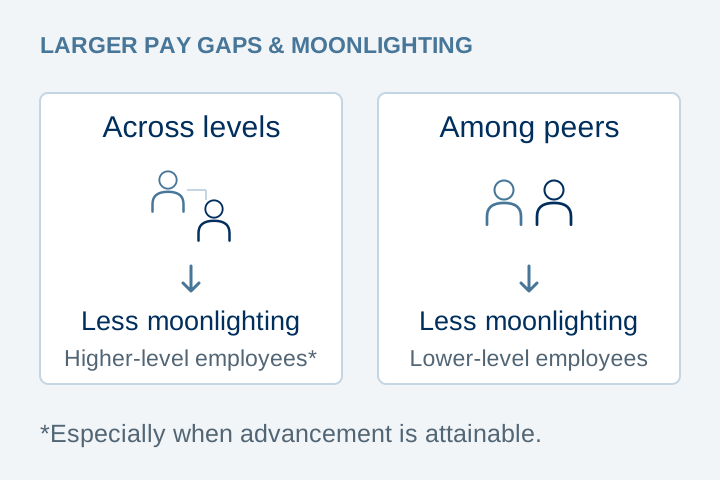
Conceptual illustration: larger pay gaps across hierarchical levels are associated with less moonlighting, especially among higher-level employees with attainable advancement. Larger pay gaps among peers reduce moonlighting among lower-level employees.
Conceptual summary from matched employer–employee data in France.
Working paper

Serving Two Masters? The Impact of Firm Wage Structures on Multiple Jobholding

with Lena Lizunova

Pay differences across levels and among peers relate to less moonlighting for different employee groups, shaping how firms retain effort as well as people.

Abstract & figure notes

Abstract

Strategic human capital research has emphasized the importance of leveraging and retaining productive talent. Yet contemporary labor markets offer increasing opportunities for secondary employment, where employees partially reallocate human capital outside the firm without formally leaving. We explore this phenomenon and theorize that internal firm wage structures shape the attractiveness of moonlighting behaviors. Using population-level employer–employee matched data from France, we show that greater vertical wage dispersion—pay differences across hierarchical levels—is associated with lower subsequent moonlighting, particularly among higher-level employees for whom advancement appears attainable. In contrast, horizontal wage dispersion –pay differences across peers—reduces moonlighting among lower-level employees. These findings reconceptualize external engagements as an ongoing effort-allocation decision and identify internal pay structures as strategic levers for limiting human capital leakage.

About the visual

An original conceptual illustration based on the author-supplied abstract. Vertical wage dispersion means differences across hierarchical levels; horizontal wage dispersion means differences among peers. The two relationships are distinguished by the employee groups emphasized in the abstract. The illustration shows direction, not effect size, and does not establish that widening pay gaps will causally reduce moonlighting in every firm.

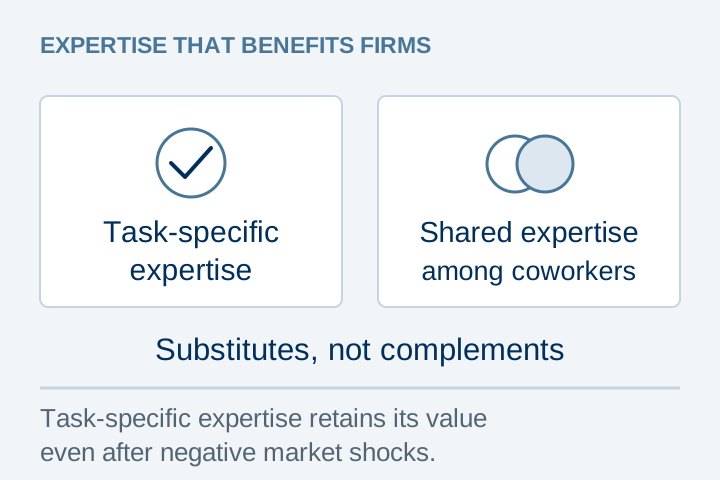
Conceptual illustration: task-specific expertise and shared expertise among coworkers both benefit firms, but act as substitutes rather than complements. Task-specific expertise benefits firms even after negative market shocks.
Conceptual summary of findings from Utah real estate.
Working paper

Specialized Human Capital in Professional Services: Task Specificity and Firm Performance

with Ryan Cooper

Task-specific expertise benefits firms even after market shocks. Shared expertise among coworkers also helps, but substitutes for specialization rather than amplifying its value.

Abstract & figure notes

Abstract

This paper examines the relationship between the autonomous specialization decisions of service professionals and the tacit human capital they develop. As individuals specialize in production in response to market and organizational factors, they develop task-specific human capital which induces them to continue to specialize. Task specificity of human capital benefits the firm due to its higher productivity, even after negative shocks to the market. Individual specialization in response to market forces also leads to human capital overlap, or shared expertise among co-workers, which may have positive and negative impacts on the firm. Using a novel approach that draws on longitudinal data from the Utah real estate industry, we examine these forces empirically and find that task-specific human capital does benefit firms, even after widespread negative market shocks. Overlap also benefits firms, though it is a substitute for task specificity rather than a complement.

About the visual

An original conceptual illustration based on the author-supplied abstract. Task-specific human capital and human capital overlap (shared expertise among coworkers) both benefit firms, but overlap substitutes for task specificity rather than complementing it. The graphic shows two sources of benefit, not an additive decomposition or estimated effect sizes. The abstract reports that the benefits of task specificity persist even after widespread negative market shocks.

Other work in progress
  • Incentives
    with Todd Zenger · Chapter for The Oxford Handbook of Organization Design. Initial chapter under review.
  • Social Affiliations, Ethical Dilemmas, and Mortgage Risk in Utah
    with Lamar Pierce and Gordon Scott
  • Social Comparisons, Death, and Federal Workers
    with Joe Raffiee
  • An Examination of Human Capital Utilization
    with the BYU Strategy Lab
Proceedings & book chapters (7)
  1. Gubler, T., Liu, H., & Roman, A. (2025). Motivational Spillovers in Repeated Tasks: How Critical 9-1-1 Calls Influence Crew Future Call Performance. Academy of Management Proceedings.
  2. Cooper, R., & Gubler, T. (2020). Specialized Human Capital in Professional Services: Task Specificity and Firm Performance. Academy of Management Proceedings.
  3. Gubler, T. (2017). Connected, but Qualified? Social Affiliations, Human Capital, and Service Professional Performance. Academy of Management Proceedings.
  4. Gubler, T. (2015). Social Affiliations and Performance of Experts in Organizations. Academy of Management Proceedings.
  5. Zenger, T., & Gubler, T. (2013). Agency Problems. Palgrave Encyclopedia of Strategic Management.
  6. Nickerson, J., Gubler, T., & Dirks, K. (2013). Trust and the Economic Theory of the Firm. Handbook of Advances in Trust Research.
  7. Butler, R. J., Johnson, W. G., & Gubler, T. (2009). Economic Burden. Work and Cancer Survivors.

Research agenda

Three connected questions.

01 / Human capital

When does expertise become an advantage?

When specialized expertise improves performance, how it moves with people across firms, and how individual contributions become an organizational advantage.

02 / Organizational systems

What shapes the work people choose to do?

Why rewards can produce unintended consequences, how professionals balance competing goals, and how demanding episodes activate capability in later work.

03 / Social capital

When do connections help, or get in the way?

How relationships open doors to valuable work and build reputations, and when familiarity leads people to choose less-qualified professionals.

Academic community

Service & recognition.

Editorial & professional service

Co-chair, Responsible Paper PrizeStrategic Management Society · 2026–present
Editorial Review Board, Strategic Management Journal2022–present
Organizer, BYU Winter Strategy Conference2025 & 2027 · Sundance, Utah
Former Senior Editor, Organization Science2023–2026
Track Chair, SMS Special ConferenceWashington, DC · 2024
Representative-at-Large, Strategic Human Capital Interest GroupStrategic Management Society · 2021–2023
Selected university service
AI Committee Lead, BYU Management Department2026–present
BYU Marriott Research Committee2025–present
BYU MBA Operating Committee2025–present
BYU Management Department Seminar Series Organizer2023–present
BYU Management Department Research Committee2022–present
Full service record in CV ↗

Selected recognition

STR Distinguished Paper AwardAcademy of Management · 2025
Strategic Human Capital Best Conference PaperStrategic Management Society · 2024
Best Conference Paper AwardWestern Academy of Management · 2022
Management Department Research AwardBrigham Young University · 2023
Sumantra Ghoshal Best Paper AwardAcademy of Management · 2017
Robert J. Litschert Best Doctoral Student Paper AwardAcademy of Management · 2015