top of page

I STUDY THE ROLE OF PEOPLE IN ORGANIZATIONAL PERFORMANCE

My research focuses on understanding the determinants of individual productivity and performance for high knowledge and skill workers in organizations. Humans are the most valuable and costly resource for organizations, and regardless of the strategy an organization chooses it ultimately relies on people to carry it out. Yet humans are also the most difficult resource for organizations to manage because they respond to extrinsic motivations, such as incentives, compensation, and awards, as well as intrinsic motivations, social comparisons, cognitive biases, and social pressures. Moreover, unlike machines, a brand, or other firm resources humans may suddenly become sick, choose to voluntarily leave to a competitor, or choose to use their autonomy in ways counterproductive to organizational objectives. 

These micro-level challenges become even more complicated in organizations. Organizational-level design, resources, structure, and other choices often directly influence the productivity, decision-making, health, and happiness of individual employees. Individual productivity and performance is also often directly influenced by the other workers present in the organization. Thus, organizations face significant challenges when seeking to leverage their human resources to successfully carry out firm objectives. 

I focus on helping firms understand how to design themselves to create and capture value more successfully through the efficient use of the people they employ. This work inherently requires a multi-level and multi-disciplinary approach, as I seek to understand individual-level decisions and productivity as well as micro-macro links that are important to individual decision-making and productivity. Empirically my research approach relies on the econometric analysis of archival field data, particularly longitudinal employer-employee matched panel data and natural experiments. To date my work has primarily focused on the following settings: 1) commercial laundry workers, 2) residential real estate, 3) emergency medical service crews and agencies (i.e., paramedics), and 4) US federal workers. 

My interests and expertise broadly fall in the following areas: Strategic human capital, social and relational capital, employee productivity, incentives and compensation, health, labor markets, multiple organizational goals, professional services, experts, knowledge workers, real estate

I joined the Organization Science editorial board as a senior editor beginning in 2023. I am also a member of the Editorial Review board for the Strategic Management Journal.

PUBLISHED WORKS

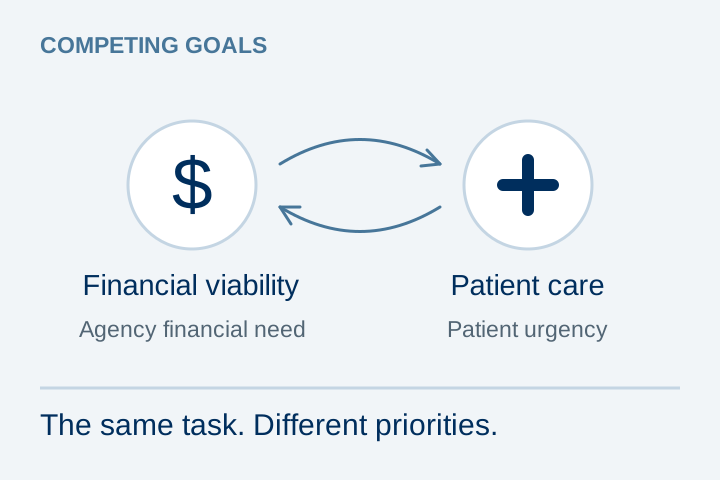
14. Gubler, T., H. Liu and A. Roman. (2025). "No Margin, No Mission? How Emergency Medical Service Crews Attend to Competing Financial and Social Goals on 9-1-1 Calls." The Strategic Management Journal, 46(13): 3118-3151. This article is open access, although you can also find it on SSRN HERE. 

13. Gubler, T., H. Liu and A. Roman. (2025). "Motivational Spillovers in Repeated Tasks: How Critical 9-1-1 Calls Influence Crew Future Call Performance. DOI 10.5465. In Sonia Taneja (Ed.), Proceedings of the Eighty-fifth Annual Meeting of the Academy of Management. Online ISSN: 2151-6561

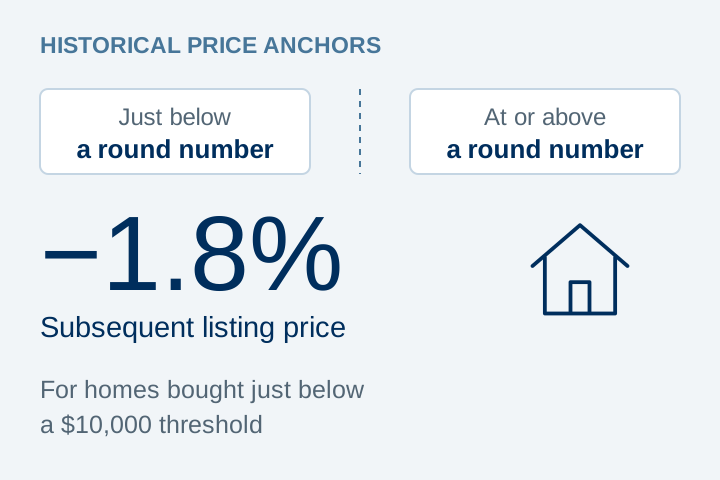
12. Gubler, T., Wiltermuth, S., and L. Pierce (2023). Anchoring on Historical Round Number Reference Points: Evidence from Durable Goods Resale Prices.Organization Science, 34(5): 1839-1863Find it on SSRN HERE.

11. Cooper, R. and T. Gubler (2020). "Specialized Human Capital in Professional Services: Task Specificity and Firm Performance", in Proceedings of the Eightieth Annual Meeting of the Academy of Management, Guclu Antinc, Ed. Online ISSN: 2151-6561.

10. Gubler, T. and R. Cooper (2019). "Socially Advantaged? How Social Affiliations Influence Access to Valuable Service Professional Transactions." Strategic Management Journal, 40(13): 2287-2314. Find it on SSRN HERE.  

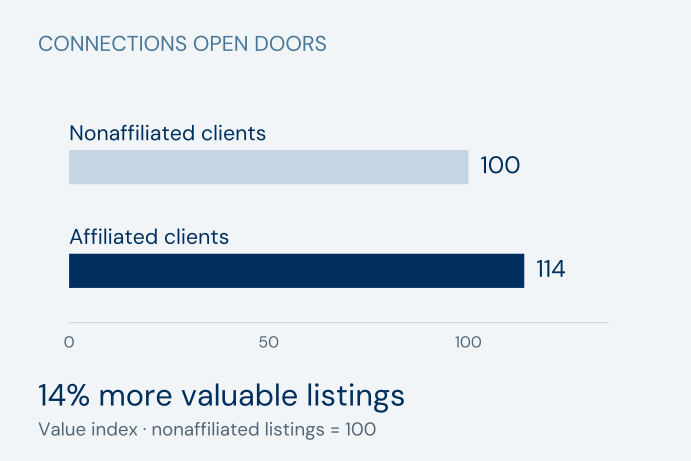
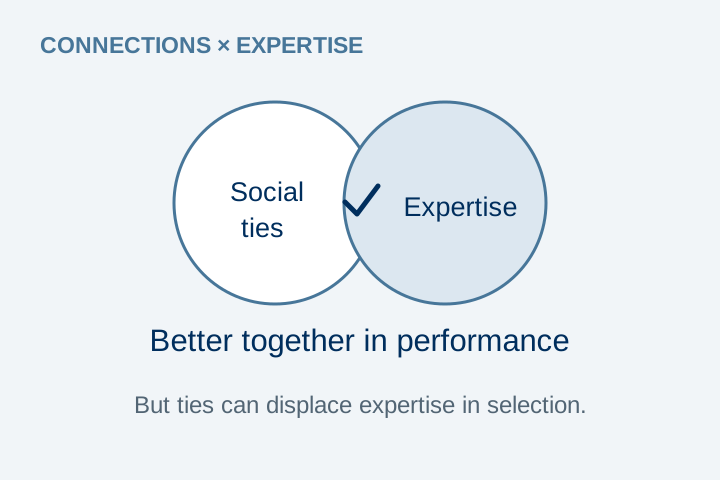
9. Gubler, T. (2019). “Connected, but Qualified? Social Affiliations, Human Capital, and Service Professional Performance." Organization Science, 30(5), 912-936. Find it on SSRN HERE.
         **Winner of Sumantra Ghoshal Best Paper Award, BPS Division, Academy of Management 2017
         **Previous Title: "When Social Capital Hurts: The Role of Human Capital Experience and Fit"
 
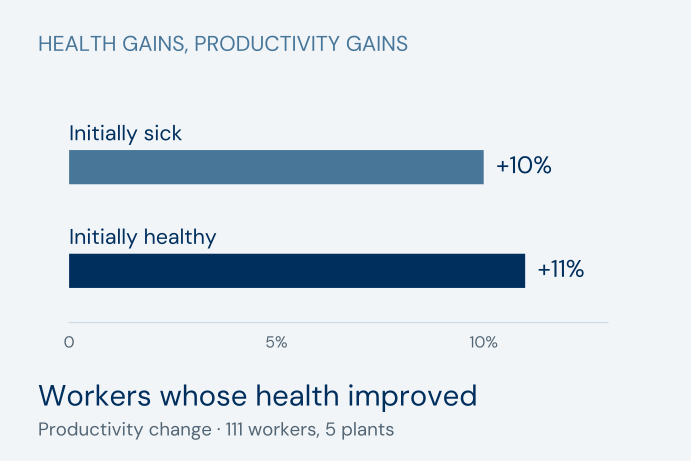
8. Gubler, T., Larkin, I., and L. Pierce (2018). “Doing Well by Making Well: The Impact of Corporate Wellness Programs on Employee Productivity.” Management Science, 64(11): 4967-4987. Find it on SSRN HERE.
         **Named top 100 business school paper by societal impact by the Financial Times

7.  Gubler, T. (2017). "Connected, but Qualified? Social Affiliations, Human Capital, and Service Professional Performance", in Proceedings of the Seventy-seventh Annual Meeting of the Academy of Management, Guclu Atinc, Ed. Online ISSN: 2151-6561. 

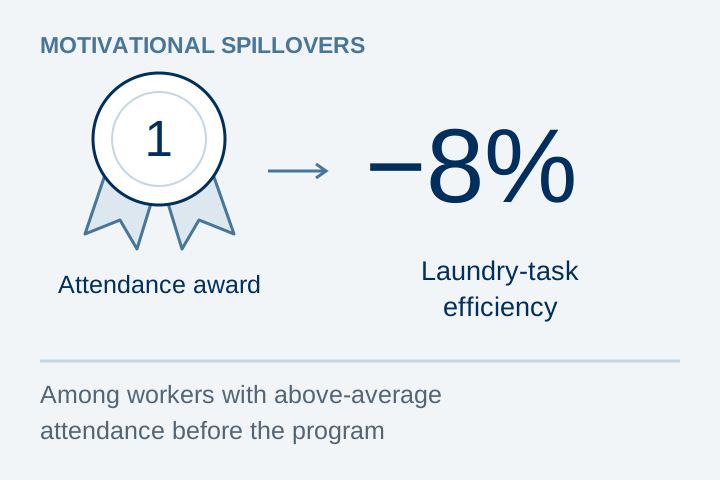
6. Gubler, T., Larkin, I., and L. Pierce (2016). “Motivational Spillovers from Awards: Crowding Out in a Multitasking Environment”, Organization Science, 27(2), 286-303. Find it on SSRN HEREPreviously titled “The Dirty Laundry of Employee Award Programs: Evidence from the Field”

5. Gubler, T. (2015). "Social Affiliations and Performance of Experts in Organizations", in Proceedings of the Seventy-fifth Annual Meeting of the Academy of Management, John Humphreys, Ed., 1:15058.

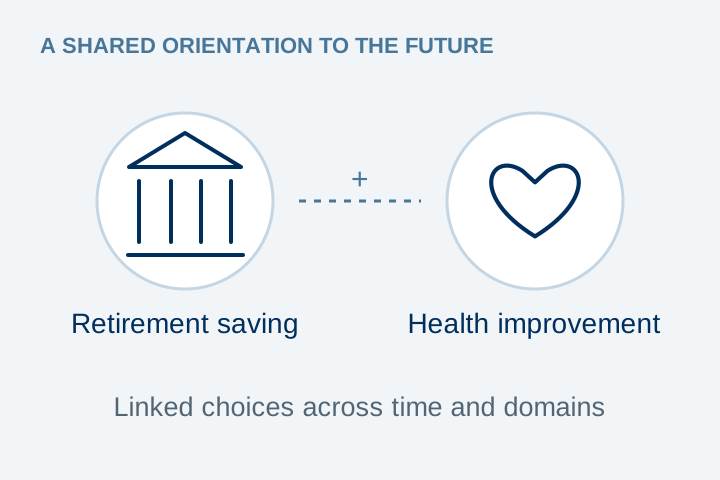
4. Gubler, T. and L. Pierce (2014). “Healthy, Wealthy, and Wise: Retirement Planning Predicts Employee Health Improvements,” Psychological Science, 25(9), 1822-1830. Find it on ResearchGate HERE.

3. Zenger, T. and T. Gubler (2013). "Agency Problems," in Palgrave Encyclopedia of Strategic Management, David Teece and Mie Augier, Eds., Palgrave Macmillan. 

2. Nickerson, J., T. Gubler, and K. Dirks (2013). “Trust and the Economic Theory of the Firm," in Handbook of Advances in Trust Research, Aks Zaheer and Reinhard Bachman, Ed., Edward Elgar (Cheltenham). Find it on ResearchGate HERE.

1. Butler, R., W. Johnson, and T. Gubler (2009). "Economic Burden," in Work and Cancer Survivors, Michael Feuerstein, Ed., New York: Springer

CURRENT WORKING PAPERS AVAILABLE PUBLICLY OR BY REQUEST
 

15. "Motivational Spillovers from Meaningful Experiences in Repeated Tasks: Evidence from Critical 9-1-1 Calls." (with Haibo Liu and Alexandru Roman). Under Review at Administrative Science Quarterly. 

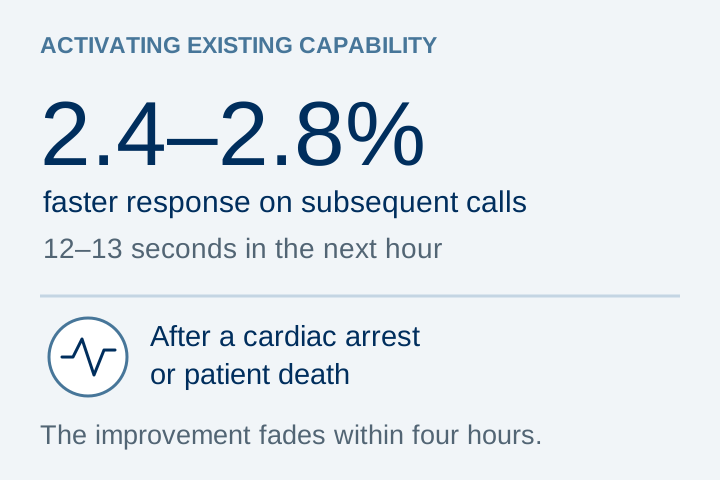
Professional employees frequently engage in repeated tasks that vary in experienced meaningfulness. In this paper, we examine how a meaningful task experience spills over to affect performance when the task is next repeated. We hypothesize and find that exposure to an acute 9-1-1 emergency call improves the subsequent performance of Emergency Medical Service (EMS) crews through a motivational spillover effect. Leveraging data from 57 million 9-1-1 calls across the United States and exploiting the quasi-random assignment of calls to EMS crews, we show that response times improve by 2.4–2.8% following a life-threatening emergency relative to a routine call. This motivational spillover is transient, dissipating within four hours, and is strongest when prior exposure to acute calls has been infrequent, with effect sizes ranging from 1.0–12.1%. The effect also diminishes with crew fatigue. Robustness checks help rule out key alternative explanations, including adrenaline or heightened salience, while supplemental interview evidence supports meaningful task experiences as the mechanism arising from reduced discrepancies between job expectations and reality. Our findings highlight the role of expectation–reality gaps in sustaining motivation and performance in intrinsically motivated occupations and suggest that strategically allocating meaningful tasks throughout the workday may enhance employee performance.

  • Winner of Distinguished Paper Award in Strategic Leadership, TMT, and Corporate Governance, STR Division, Academy of Management Annual Meeting Copenhagen, Denmark (2025).

  • Winner of best conference paper award for the Strategic Human Capital Interest Group, Strategic Management Society Annual Meeting Istanbul, Turkey, (2024).


16. "Serving Two Masters? The Association Between Firm Wage Structures and Employee Moonlighting Behaviors." (with Lena Lizunova). Working Paper. Available by request.

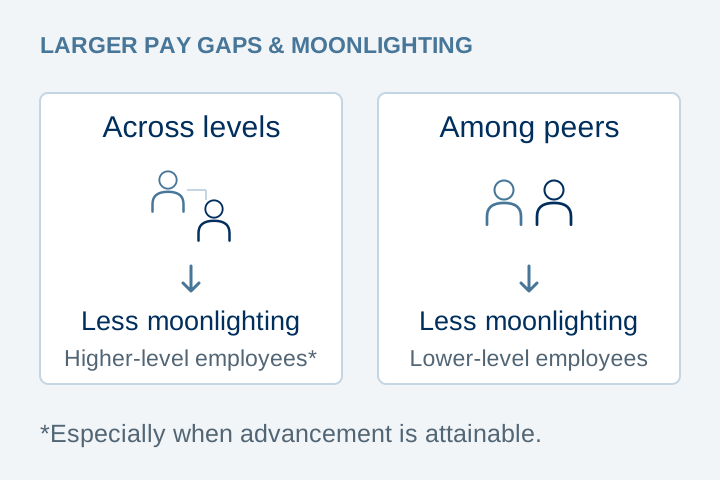
Strategic human capital research has emphasized the importance of retaining productive talent. Yet contemporary labor markets offer increasing opportunities to moonlight, which enables employees to partially reallocate human capital outside the firm without formally leaving. We explore this phenomenon and theorize that internal firm wage structures shape moonlighting behaviors by signaling returns to internal investment. Using population-level employer–employee matched data from France, we show that greater vertical wage dispersion—pay differences across hierarchical levels—is associated with lower subsequent moonlighting, particularly among higher-level employees for whom advancement appears attainable. In contrast, horizontal wage dispersion –pay differences across peers—reduces moonlighting among lower-level employees. These findings reconceptualize external engagements as an ongoing effort-allocation decision and identify internal pay structures as strategic levers for limiting human capital leakage.

17. "Individual-level Origins of Firm-level Human Capital Resources" (with Ryan Cooper and David Kryscynski). Working paper. Available by request.

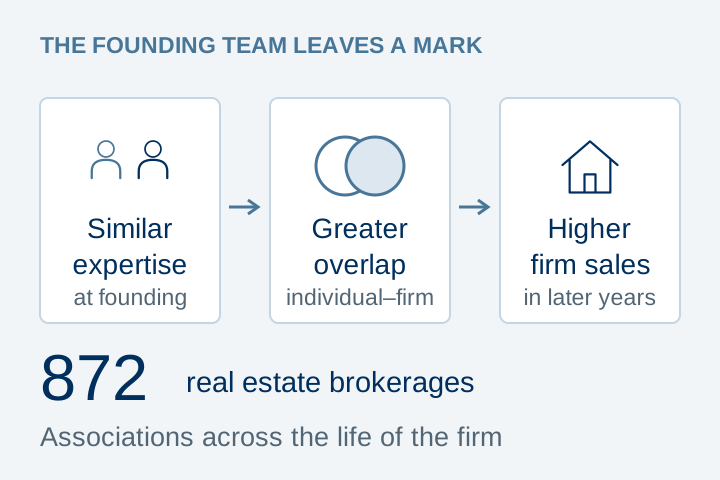
Understanding the emergence of firm-level human capital resources from individual-level human capital is crucial to explaining how firms can create and sustain competitive advantage from their people. We theorize that higher similarity among the individual-level components of a firm’s founding human capital resource leads to higher subsequent average overlap between individuals and the established firm-level human capital resource, and that this higher overlap improves firm performance. Analysis of individual- and firm-level human capital portfolios constructed using data from 872 real estate brokerages suggests that higher individual-level human capital similarity among agents at founding positively relates to individual-firm human capital overlap in future years, and that higher individual-firm human capital overlap positively relates to future firm sales. These results imply that managers from founding onward must carefully craft and manage individual- and firm-level human capital resources to generate persistent performance advantages.

18. "Credentials, Connections, or Competence? How Consumers Choose Service Professionals" (with Ryan Cooper and Jim Oldroyd). Working Paper. 

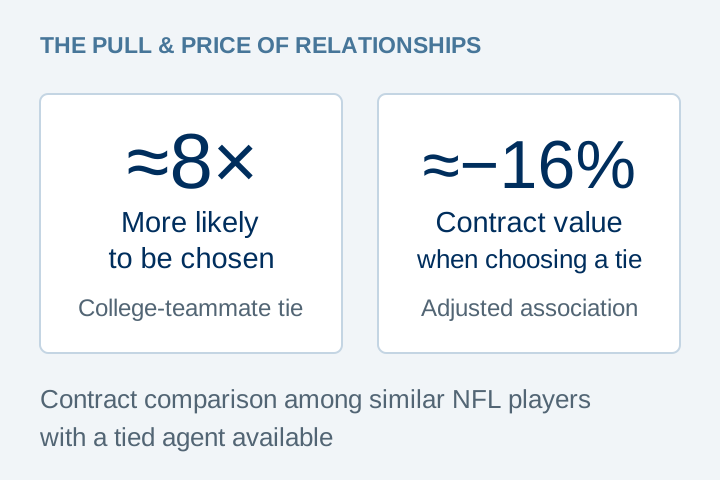
Professional service firms offer credence goods, making quality assessment difficult. Using National Football League data, we examine how agents' credentials (human capital), connections (social capital), and reputation (competence) influence player selection. We test how the credentials, connections or competence of agents impact players' selection decision. Results show social capital is more important than human or reputational capital in initial and subsequent agent choices. This persists even as players gain experience. Finding suggests professional service providers should emphasize their networks and connections over credentials or track records when attracting clients, as social capital proves the dominant factor in client selection decisions. 

19. "Specialized Human Capital in Professional Services: Task Specificity and Firm Performance." (with Ryan Cooper). Working Paper. 

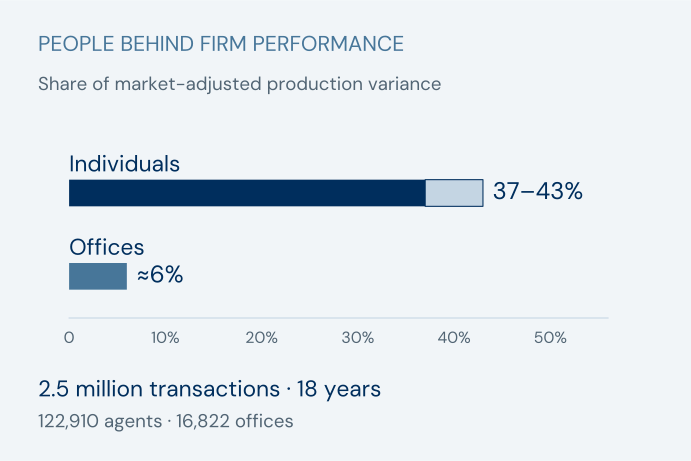
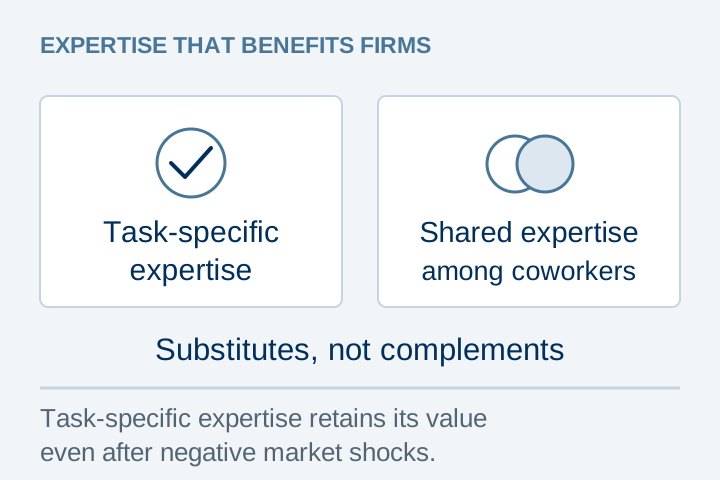
This paper examines the relationship between the autonomous specialization decisions of service professionals and the tacit human capital they develop. As individuals specialize in production in response to market and organizational factors, they develop task-specific human capital which induces them to continue to specialize. Task specificity of human capital benefits the firm due to its higher productivity, even after negative shocks to the market. Individual specialization in response to market forces also leads to human capital overlap, or shared expertise among co-workers, which may have positive and negative impacts on the firm. Using a novel approach that draws on longitudinal data from the Utah real estate industry, we examine these forces empirically and find that task-specific human capital does benefit firms, even after widespread negative market shocks. Overlap also benefits firms, though it is a substitute for task specificity rather than a complement. 

WORK IN PROGRESS (but not yet full working papers)
 

20.  “Social Affiliations, Ethical Dilemmas, and Mortgage Risk in Utah" (with Lamar Pierce). Data analysis stage.

In this paper we investigate whether social affiliations and relational capital between real estate agents and buyers leads agents to provide better advice and reign in potentially self-destructive buyer impulses or if it leads agents to enable buyers to achieve their dreams, regardless of the risks. 

21.  "Human Capital, Discrimination, and Stigma within the Federal Workforce" (with Joe Raffiee). Data analysis stage.

In this project we investigate how exogenous natural shocks to perceptions of race influence the promotion, turnover, and hiring of minority workers. We explore these questions using a database of all federal workers in the US government from 1974-2014. 

NOTABLE MEDIA MENTIONS

EDITORIAL BOARDS AND REVIEWING

  • Senior editor, Organization Science (2023-current)

  • Editorial Review Board member, Strategic Management Journal (2023-present)

  • Editorial Review Board member, Organization Science (2021-2023)

  • Ad hoc reviewer: Management Science, Administrative Science Quarterly, Academy of Management Journal, Production and Operations Management, Organizational Behavior and Human Decision Processes, Review of Economics and Statistics, and Human Relations. 

MAJOR HONORS AND AWARDS

  • Winner of Distinguished Paper Award in Strategic Leadership, TMT, and Corporate Governance, STR Division, Academy of Management Annual Meeting Copenhagen, Denmark (2025).

  • Winner of best conference paper award for the Strategic Human Capital Interest Group, Strategic Management Society Annual Meeting Istanbul, Turkey, (2024).

  • Management Department Research Award, Brigham Young University, 2023.

  • President's Innovation Award Recipient, Brigham Young University, 2022. $85,000

  • Innovative Learning Technology Initiative Grant Recipient, University of California, Riverside (with Marlo Raveendran), 2018. $107,000

  • Winner of Sumantra Ghoshal Best Paper Award, Academy of Management, 2017, Atlanta, Georgia.


  • MBA Golden Apple teaching award, University of California, Riverside. Student-voted award for best MBA teacher in MBA core courses for 2016-2017.

  • Winner of Robert J. Litschert Best Doctoral Student Paper Award, Academy of Management 2015, Vancouver, Canada.

  • Finalist: Strategic Human Capital interest group best paper award, Strategic Management Society 2015, Denver, Colorado.

  • Moog Scholar, Washington University in St. Louis, 2013-2014.

© 2025 by TIMOTHY GUBLER

  • Twitter Metallic
  • s-linkedin
bottom of page